
Introduction
Designing a home in Dubai or anywhere in the UAE is not only about choosing luxury furniture or trendy colors, but it is also about creating a space that feels comfortable, practical, and visually pleasing at the same time.
Many homeowners often ask, what are the 7 principles of interior design?, because they want their homes to look professionally designed without making costly mistakes. Interior designers across the world follow these core guidelines to make sure that every room feels balanced, functional, and welcoming.
Leading companies in the UAE, including Atech Interiors LLC, rely on these time-tested principles to deliver interiors that match both modern lifestyles and local preferences.
When the principles of interior design are explained properly, they become simple and easy to follow even for beginners. These principles are not trends that change every year, but foundational rules that help organize furniture, colors, lighting, and decorative elements in a meaningful way.
Understanding them will help you see why some rooms feel comfortable and attractive while others feel crowded or incomplete.
7 Basic Principles of Interior Design
The 7 principles of interior design are widely taught in design schools and followed by professionals around the world. These principles help create a sense of order, comfort, and visual flow inside a space.
When designers talk about Interior design elements and principles, they are referring to how space, line, color, texture, form, and light are arranged according to these rules to create a well-planned interior.
Here is the complete 7 interior design principles list that designers use in residential and commercial projects:
- Balance
- Harmony
- Rhythm
- Proportion and Scale
- Emphasis
- Contrast
- Details
1. Balance: Creating a Sense of Visual Stability
Balance means distributing visual weight evenly throughout a room so that one side does not feel heavier than the other.
Designers usually work with three types of balance, which are symmetrical balance, where elements are mirrored, asymmetrical balance, where different items of equal visual weight are used, and radial balance, where elements are arranged around a central point, such as a chandelier or round table.
Research in environmental psychology shows that balanced spaces make people feel more relaxed and comfortable because the room feels stable and organized.
In Dubai villas and apartments, balance becomes important when using large sofas, statement lighting, or bold feature walls. For example, if a large sectional sofa is placed on one side of the living room, designers may balance it with two armchairs, artwork, or tall plants on the opposite side.
For those exploring Interior design principles for beginners, balance is often the easiest principle to understand and apply because you can visually see when a room feels uneven.
2. Harmony: Bringing All Elements Together

Harmony is about making sure that all elements in a room work together instead of competing with each other. Designers often use a consistent color palette, usually two to four main colors, to maintain harmony throughout the space.
Studies in color psychology show that coordinated color schemes create a sense of calmness and comfort, which is why harmony plays a key role in residential interiors.
In modern UAE homes, harmony can be achieved by repeating materials such as wood, marble, or metal finishes in different areas of the room. Furniture styles should also complement each other so that the design feels intentional rather than random.
This is especially important when applying Interior design principles for modern homes, where clean lines and coordinated finishes define the overall look.
3. Rhythm: Guiding Movement Within the Design
Rhythm creates movement in a room and guides the eye from one area to another in a natural way. Designers create rhythm through repetition, progression, and alternation, which means repeating certain colors, shapes, or patterns across the space. For example, using the same accent color in cushions, artwork, and rugs helps connect different parts of the room visually.
Large open-plan homes in Dubai benefit greatly from rhythm because it helps connect living, dining, and kitchen areas smoothly. Without rhythm, open spaces can feel disconnected or confusing. When you understand how to use repetition and flow properly, you begin to see clearly how to apply interior design principles in your own home.
4. Proportion and Scale: Building the Base of Good Design
Proportion refers to how different elements relate to each other, while scale refers to how those elements relate to the size of the room.
Designers often use a general guideline where large rooms can handle bigger furniture pieces, while smaller spaces require more compact and multifunctional furniture. According to design experts, incorrect scale is one of the most common mistakes homeowners make when decorating their homes.
In UAE properties where ceiling heights can be quite tall, using small lighting fixtures may make the space feel empty and incomplete. On the other hand, oversized furniture in a small apartment can block movement and reduce comfort. Understanding proportion and scale ensures that every item fits well within the space and supports the overall layout.
5. Emphasis: Designing Strong Focal Points
Emphasis means creating a focal point that naturally attracts attention when someone enters the room. Designers believe that every room should have one main feature, because without it, the space can feel flat or confusing. This focal point could be a large window view, a feature wall, a fireplace, or a statement piece of furniture.
Some common ways designers create emphasis include:
- Using bold colors on one wall while keeping others neutral
- Placing artwork at eye level to draw attention
- Installing dramatic lighting fixtures in the center of the room
In luxury Dubai homes, focal points often include custom TV walls, marble panels, or decorative ceilings. Emphasis helps anchor the design and gives the room personality.
6. Contrast: Enhancing Depth and Visual Interest
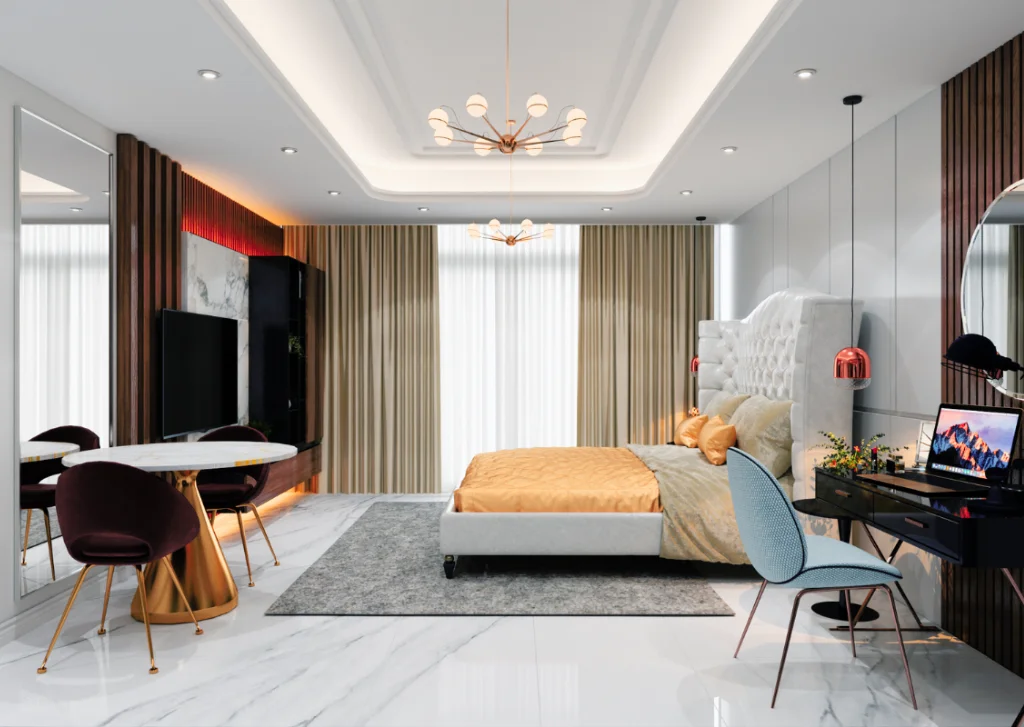
Contrast adds excitement to a room by combining opposite elements in a balanced way. Designers often mix light and dark colors, smooth and rough textures, or modern and classic furniture styles to create depth. Without contrast, a room may look too plain or boring.
For example, pairing a dark sofa with light-colored walls instantly creates visual interest. Adding metal accessories to a soft fabric setting also enhances variation. When used correctly, contrast strengthens the overall impact of the design while keeping it visually engaging.
7. Details: Adding the Final Finishing Touches
Details are the small elements that complete the design and make it look professional. Interior experts often say that details can account for the difference between an average room and a high-end interior. This includes carefully selected handles, trims, stitching, lighting placement, and decorative accessories.
In Dubai’s premium residential market, attention to detail is extremely important because clients expect refined finishes and polished results. Even aligning patterns properly or choosing matching handles or fittings can elevate the overall appearance.
When combined together, these finishing touches strengthen the 7 principles of interior design and make the space feel thoughtfully designed.
Conclusion
If you have ever wondered, what are the 7 principles of interior design?, then you can clearly see how each principle plays a practical role in shaping beautiful and functional spaces. From balance and harmony to contrast and details, these guidelines help organize every element in a room in a meaningful way.
The 7 principles of interior design are not complicated rules but simple foundations that designers use daily in projects across Dubai and the UAE.
By understanding these concepts and applying them carefully, you can create interiors that feel comfortable, organized, and visually appealing. Whether you are renovating a villa, upgrading an apartment, or planning a commercial space, these principles will always remain the core of successful interior design.
FAQs – Frequently Asked Questions
1. What are the core principles of interior design, and how do they work together?
The core principles are balance, harmony, rhythm, proportion and scale, emphasis, contrast, and details. They work together to create spaces that feel visually stable, functional, and aesthetically pleasing.
2. How do the principles of interior design help in creating a balanced and functional space?
They guide the placement of furniture, selection of colors, and use of focal points so that a space feels organized, comfortable, and easy to use.
3. Can the principles of interior design be applied in small UAE apartments?
Yes, applying proper scale, light color harmony, and smart balance can make small UAE apartments feel more spacious, practical, and visually appealing.
4. What is the difference between interior design principles and interior design elements?
Interior design elements are the physical components, like color, texture, and space, while principles are the rules that organize those elements into a cohesive design.
5. How can beginners apply the principles of interior design effectively?
Beginners can start by choosing a focal point, maintaining color harmony, balancing furniture sizes, and repeating patterns thoughtfully to create a well-designed space.