

A fit-out schedule can be put at risk before work begins if drawings, approval responsibilities and project decisions are not aligned. For teams focused on avoiding fit out delays Dubai municipality, the practical starting point is a coordinated submission, with review stages reflected in procurement and site planning.
Authority review is only one potential source of delay. Incomplete information, late design changes and mismatched timelines between the landlord, design team and fit-out team can also lead to repeated reviews or leave site activities waiting. Since approval routes vary by project location and scope, identify the applicable authority and building requirements early.
This guide explains how to spot approval risks before submission, coordinate technical decisions with procurement and scheduling, and manage review comments without losing control of the project. Atech Interiors LLC brings Dubai Municipality approval support together with fit-out and renovation coordination, connecting documentation with site delivery.
Key Takeaways
- Start avoiding fit out delays Dubai municipality by confirming the approval route, submission owner and decision-makers before documentation begins.
- Use a readiness sequence to align project scope, drawings and required inputs before formal review.
- Track review comments, assign an owner to each response and coordinate revisions before resubmission.
- Build the programme around approval milestones and project-specific assumptions, not guaranteed review dates.
- Coordinate regulatory submissions with procurement and site sequencing so fit-out decisions and delivery activities stay aligned.
Why Fit-Out Projects Face Avoidable Dubai Municipality Delays
An avoidable delay often starts when approval dependencies are not coordinated with design decisions and site activities. Authority review time is one part of the programme. Waiting for complete drawings, resolving unclear scope or revising documents after a late change are project-side dependencies that can postpone submission or trigger another review cycle.
For teams focused on avoiding fit out delays Dubai municipality, it is useful to separate these causes. The relevant authority controls its review period, so it should not be treated as a guaranteed date. Project teams can, however, reduce preventable waiting by agreeing the fit-out scope, assigning submission responsibilities and resolving technical interfaces before drawings are finalised. Approval readiness needs to align with design coordination and site planning so unresolved information does not hold up submissions, procurement or mobilisation.
Where approval and fit-out schedules commonly lose time
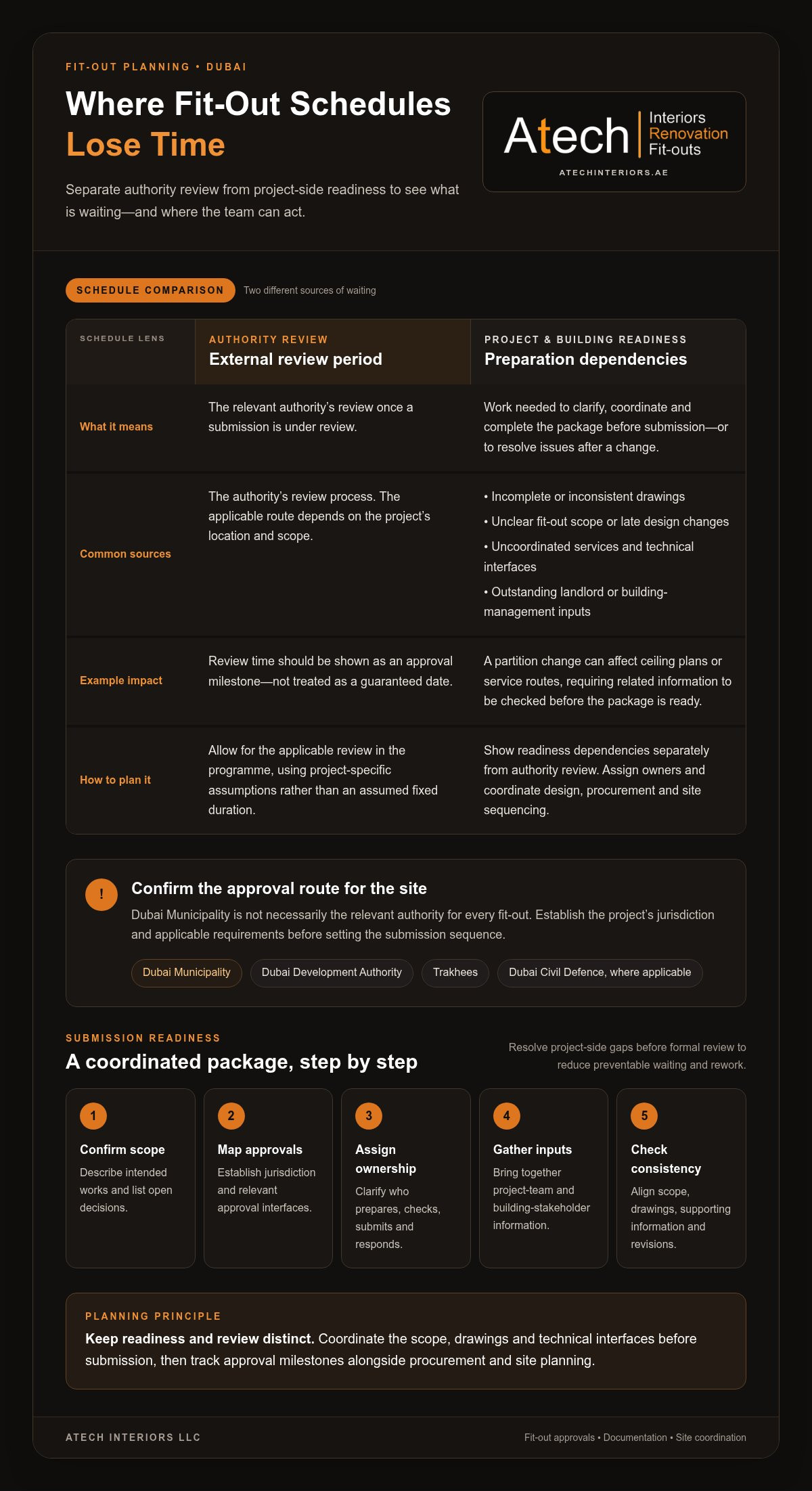
Submission preparation can stall when the proposed layout is still changing, drawings are incomplete, or building services and other technical interfaces have not been coordinated. For example, a late partition change may affect ceiling plans or service routes. The related information then needs to be checked for consistency before the package is ready to submit.
Landlord and building-management inputs can also affect the submission sequence. If access conditions, building requirements or required documents are still being clarified, the team may lack information needed to complete its package. Show these dependencies separately from authority review time in the programme. One concerns readiness within the project or building; the other begins once the submission is under review. Tracking both makes it easier to see where action is needed without assuming a fixed review duration.
Why Dubai projects need a location-aware approval plan
Dubai Municipality is not necessarily the relevant authority for every fit-out. The route depends on the project’s location and scope, and may involve Dubai Municipality, Dubai Development Authority, Trakhees or Dubai Civil Defence where applicable. The Dubai Municipality overview provides general background on the authority, but does not establish which approvals apply to a specific site.
Before setting a submission sequence, establish the project’s jurisdiction and identify the requirements that apply to its location and scope. This helps the team plan for relevant reviews and dependencies rather than building a programme around the wrong approval route. A location-aware plan gives design, documentation and site scheduling a shared basis for sequencing the work.
How to Prepare a Fit-Out Submission Before Dubai Municipality Review
A submission is easier to coordinate when the team agrees on the project scope, approval responsibilities and decision-making process before documentation begins. Use a readiness sequence to identify gaps and keep the package aligned with the fit-out programme. Document requirements and approval routes depend on the project, so use the Dubai Municipality Official Website and other relevant official sources to establish what applies to the specific site and scope.
Confirm scope, site jurisdiction, and approval responsibilities
Start by recording the unit and building, proposed works, landlord requirements and known authority interfaces. Then clarify who prepares and reviews the submission, who submits it, and who can approve design or scope decisions. Clear ownership prevents information from sitting between parties when a clarification or revision is needed.
- Step 1: Confirm the scope. Describe the intended works and list decisions that are still open.
- Step 2: Map approvals. Establish the site’s jurisdiction and identify the approval interfaces that apply to the project.
- Step 3: Assign ownership. Name the people responsible for preparing, checking, submitting and responding to approval information.
Coordinate drawings and technical information before submission
Before finalising the package, check that the drawings reflect the agreed layout and fit-out scope, including partitions, ceilings, finishes and relevant services. Coordinate architectural and MEP information wherever the design affects shared interfaces, such as ceiling zones, service routes or equipment locations. Requirements vary with project scope, so use the applicable authority’s current requirements rather than relying on a generic checklist.
Keep one controlled drawing set and a clear revision record. This gives the team a common reference for review and helps prevent outdated drawings from being used for procurement or site planning. If a design decision changes after coordination, identify the related documents and interfaces that need updating before submitting the package.
- Step 4: Gather project inputs. Bring together information required from the project team and building stakeholders.
- Step 5: Check consistency. Confirm that the scope, drawings, supporting information and revision references align.
Readiness check: Is the scope agreed? Is the approval route mapped? Are submission ownership and decision-makers clear? Do the coordinated drawings reflect the intended work, and are revisions controlled? Resolving gaps at this stage supports avoiding fit out delays Dubai municipality by reducing preventable preparation issues and rework. Atech’s Dubai Municipality approval support coordinates regulatory submissions, documentation and compliance checks alongside interior works.
How to Manage Dubai Municipality Review Comments Without Rework
A completed submission is not a confirmed approval, so it should not be treated as a fixed start date for site work. The review may generate comments that require clarification or drawing revisions. Allow time in the programme for a coordinated response and any further review. For avoiding fit out delays Dubai municipality, make each response traceable and coordinated instead of revising documents in isolation.
Build a clear comment-response and revision process
Record every review comment in a tracker with its reference, required action, responsible person, status and revised drawing reference. The assigned owner should prepare a response and coordinate it with the relevant disciplines before issuing revised information. For example, a change to an architectural drawing may also need to be checked against services information so the resubmission presents a consistent design.
A controlled resubmission is a coordinated, traceable revision package that links each review comment to its response and the documents updated to address it. Keep superseded information separate from the current set, and make the revision record clear to everyone using the documents. This reduces the risk of a team member relying on an outdated drawing while a revised package is under review.
- Log each comment and identify the action needed.
- Assign an owner and agree on the response before revising documents.
- Coordinate affected drawings and technical information across disciplines.
- Record revision references and keep superseded files separate.
- Check the complete package before resubmission.
Control design changes while approvals are in progress
Authority-requested revisions and voluntary scope changes are different. A comment response addresses a point raised during review; a client or project-team change may introduce new information that affects the submitted scope. Put proposed changes through a documented impact review before updating the package, rather than adding revisions informally.
Assess each change against the submission, landlord or building interfaces, procurement decisions and planned site activities. A revised partition layout, for instance, could affect coordinated drawings as well as materials being considered for purchase. Record what is changing, why, which documents are affected and who approved the decision. Then establish whether revised approval information is required. Do not assume the original review automatically covers a changed scope.
The Dubai Building Code is an official reference for design and construction requirements in Dubai. For an active submission, use project-specific comments and applicable procedures to guide the response. A consistent review loop helps the team control revisions while keeping technical information and delivery planning aligned.
How to Keep Dubai Fit-Out Scheduling Aligned with Approval Milestones
A fit-out programme should show how approval status affects design release, procurement and site activity. Treat submission, review and any required revisions as dependencies, not guaranteed dates. Build the sequence around project-specific assumptions and update it as information changes. This makes avoiding fit out delays Dubai municipality an active coordination task rather than a matter of relying on an optimistic fixed date.
A practical sequence is:
- Design coordination: Resolve scope and coordinate relevant architectural and technical information.
- Submission: Confirm the package is ready and record its submission status.
- Review and revisions: Allow for authority comments, assigned responses and any coordinated resubmission.
- Mobilisation: Align site access, logistics, workforce planning and approved work packages with applicable approvals.
- Execution and inspection: Sequence works against the project’s relevant approval conditions and inspection requirements.
Some preparation can proceed in parallel with review. The team can plan site logistics, coordinate access, prepare procurement information and sequence trades, while clearly identifying purchases or work that depend on an approved or settled scope. Planning readiness does not authorise work that must wait for applicable approvals.
Connect approval dependencies to procurement and site readiness
Map each work package to its decision points. For example, identify which finishes, partitions or services depend on a settled layout before releasing related procurement or site instructions. Review these links with the client, design team, fit-out team and building stakeholders. That way, a change in approval status is reflected in the programme instead of being discovered when a trade is ready to proceed.
Use a simple tracker that records:
- Owner responsible for the next action
- Approval or information dependency
- Current status and latest update
- Next action and decision deadline
Escalate risks early and protect decision time
Set internal review dates ahead of planned submission and response milestones, leaving time to resolve missing inputs before they affect the sequence. Escalate overdue decisions and unresolved technical interfaces to named owners, and record how each issue affects procurement or site readiness. Wider planning principles can also inform a commercial fit-out delivery guide, while the approval-linked programme should remain specific to the project.
Atech Interiors coordinates Dubai Municipality approval submissions, documentation and compliance checks alongside fit-out and renovation work. Its approval and fit-out coordination connects project decisions, technical information and site sequencing.
How Atech Interiors Coordinates Dubai Municipality Approvals and Fit-Out Delivery
Approval coordination is most effective when it stays connected to the interior scope and planned delivery sequence. Atech Interiors LLC supports fit-out and modification projects through regulatory drawing submissions, documentation and compliance checks, alongside interior fit-outs, office fit-outs and renovations in Dubai. This coordinated approach helps the project team work from aligned information as the submission and site programme progress.
What coordinated approval support contributes to a fit-out
Submission drawings and supporting documentation need to reflect the defined works. Atech coordinates approval information against the project scope and relevant technical details, helping identify inconsistencies that could lead to clarification or revisions. Approval activities can also be aligned with planned work packages, so design decisions, documentation and site sequencing are considered together rather than managed as separate tracks.
For example, if an interior project includes changes to partitions, ceilings or services, the relevant drawings and technical information should present a coordinated proposal. The submission route and requirements depend on the site and project scope, so plan the approval process around the applicable jurisdiction and current requirements. This coordination supports avoiding fit out delays Dubai municipality, while recognising that the authority determines its review period and decision.
Practical next steps for a project team in Dubai
Before planning the submission sequence, bring together a clear picture of the project. Useful starting information includes:
- Site details: The unit and building location, plus known landlord or building-management requirements.
- Intended works: A concise description of the fit-out, renovation or modification scope.
- Existing information: Available drawings and relevant technical details that show the current project position.
- Programme priorities: The desired sequence for design, submission, procurement and site activities.
- Known dependencies: Open decisions, stakeholder inputs or technical interfaces that could affect readiness.
With these inputs, Atech coordinates regulatory submissions and compliance checks with the interior project information and sequencing. A clear scope and a record of known dependencies give the team a practical basis for assigning responsibilities and identifying where coordination is needed, while the authority retains responsibility for its review and decision.
For approval coordination on a Dubai fit-out project, discuss your Dubai fit-out project.
Put Approval Coordination at the Centre of Your Fit-Out Plan
Avoiding fit out delays Dubai municipality starts with treating approvals as part of project delivery, not as a separate administrative step. Confirm the applicable route and submission responsibilities early, coordinate drawings and technical information before submission, and track review comments through a controlled response process.
Keep approval milestones visible in the programme alongside procurement and site activities. Use project-specific assumptions, identify dependencies and escalate open decisions before they affect the next stage. This supports better coordination while recognising that authority review periods and decisions remain outside the project team’s control.
Atech Interiors manages regulatory drawing submissions, documentation and compliance checks for fit-out projects, and delivers interior fit-outs, office fit-outs and renovations in Dubai. For a coordinated approach that brings approval support and project sequencing together, discuss your Dubai fit-out project. With clear responsibilities and well-managed information, your team can move forward with greater confidence.
Frequently Asked Questions
What causes delays in Dubai Municipality fit-out approvals?
Delays commonly arise when drawings or supporting information are incomplete, inconsistent or misaligned with the proposed scope. Late decisions, unresolved technical interfaces, missing landlord inputs and design changes can also hold up submission preparation or lead to revisions during review. Authority review time is separate from these project-side dependencies. To avoid fit out delays Dubai municipality, identify information owners and scope decisions early, then coordinate the package before submission.
How can I avoid fit-out approval delays in Dubai?
Prepare the submission around an agreed scope, a confirmed approval route and coordinated project information. Assign owners for preparing, checking, submitting and responding to documents before work begins. Coordinate architectural drawings with relevant MEP information, track revisions, and allow for review comments and resubmission if required. Align procurement and site planning with approval dependencies instead of assuming review dates are guaranteed or proceeding with unresolved information.
How long does Dubai Municipality approval take for a fit-out?
There is no single reliable approval duration for every Dubai fit-out. The review period depends on factors such as project scope, submission completeness, the applicable approval route and whether comments require revised information. Build the programme using assumptions relevant to the specific submission, and distinguish authority review time from time spent resolving internal or stakeholder inputs. Do not treat an estimated date as a guaranteed approval or site-start date.
Can fit-out work start before Dubai Municipality approval?
Do not assume that work requiring approval can begin before the relevant approval is in place. Requirements and permissions depend on the project’s location, scope and authority route, as well as building or landlord requirements. Establish the conditions that apply to the specific fit-out before instructing site work. While approvals are in progress, the team can coordinate logistics and prepare sequencing, but planning activity does not authorise restricted work.
What documents are needed for Dubai Municipality fit-out approval?
Submission requirements vary according to project scope and the applicable route. A package may include drawings that accurately describe the proposed interior works, relevant technical information and supporting documentation required for the application. Landlord or building-management inputs may also affect readiness. Start by defining the scope and establishing the current requirements for the project, then check that drawings and supporting information are consistent. A generic document list is not a substitute for project-specific guidance.
Does every Dubai fit-out require Dubai Municipality approval?
Not necessarily. The applicable authority and approval route depend on the project’s location and scope, so Dubai Municipality may not be responsible for every site. Other jurisdictions, including Dubai Development Authority or Trakhees, may apply in relevant locations. A particular project may also have additional approval interfaces. Establish the site jurisdiction and applicable requirements before identifying approvals as mandatory or setting the submission sequence.
How should a contractor respond to Dubai Municipality review comments?
Log each comment, assign an owner, agree on the response, revise the affected information and coordinate related drawings before resubmitting. Track the comment reference, action, status and revised drawing reference so each response can be traced. Keep superseded files separate from the current set to reduce the risk of site or procurement teams using outdated information. Assess proposed scope changes separately, since they may affect the submission and require revised approval information.